


Personnalisation des t-shirts imprimés à la demande : choisir le bon fournisseur
Temps de lecture estimé : ~5 minutes
In the fast-evolving world of fashion, Print on Demand (POD) shirts have become a game-changer for brands. They allow entrepreneurs to launch collections of T-shirts, hoodies, denim shirts, and hybrid pieces with minimal upfront inventory and risk. For growing startups that already have a foundation but are hunting for more reliable or versatile suppliers, upgrading your customization options can make all the difference between average products and standout bestsellers.
Whether you’re expanding from basic tees into premium streetwear hoodies or adding durable denim elements, the key lies in advanced customization techniques paired with the right fabric weights. From lightweight 190-300gsm cottons ideal for breathable T-shirts to mid-to-heavy 300-600gsm options that give structure to hoodies and premium denim shirts, the possibilities are vast. Suppliers offering one-stop services—from fabric selection and small MOQ production to full customization—help brands test ideas quickly and scale confidently.
This guide explores popular POD customization methods (including flat embroidery, heat transfer, screen printing, 3D all-over print, hand-painted effects, tie-dye, embroidered patches, puff printing, silicone printing, flock coating, rhinestone application, towel embroidery, reflective and fluorescent inks, digital embroidery, 3D embossing, and toothbrush-style embroidery), common design and production challenges, and how to address doubts when switching suppliers.
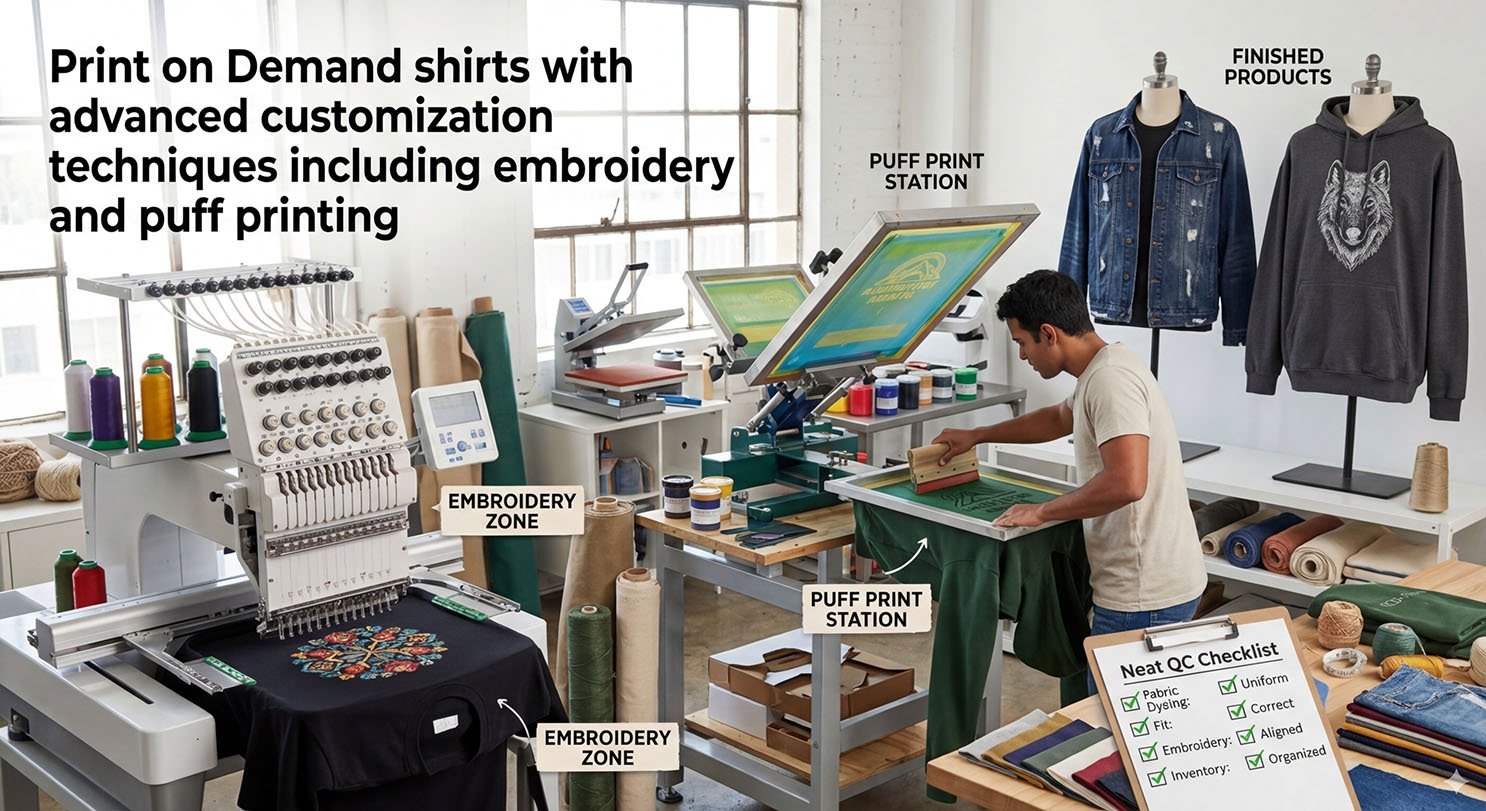
Diversified POD clothing
Print on Demand Shirts – Expanding Your Apparel Line
Print on Demand means producing garments only when ordered, eliminating large minimums and excess stock. This model shines for T-shirts (casual everyday wear), hoodies (cozy streetwear staples), and denim shirts or jackets (for structured, durable pieces with vintage appeal).
While classic heavyweight denim (often 450-600gsm with stonewash or enzyme finishes) provides timeless durability and a premium hand-feel, it’s only part of a successful line. Lightweight knit fabrics (190-300gsm) deliver soft, breathable T-shirts perfect for detailed prints. Mid-to-heavy weights (300-450gsm fleece or French terry) create comfortable yet structured hoodies that hold shape after repeated washes. Heavier options up to 600gsm support robust denim-inspired shirts that feel substantial and high-end.
Versatile suppliers can handle mixed collections under one roof, offering custom knitwear and woven denim with flexible GSM ranges. This setup is ideal for startups ready to move beyond current limitations and introduce seasonal innovations across casual, street, and elevated categories.
Advanced Customization Techniques for POD Shirts and Apparel
Choosing the right technique depends on your design complexity, target fabric weight, desired durability, wash-fastness, and budget. Here’s a breakdown of key methods suitable for T-shirts, hoodies, and denim pieces:
Digital and Flat Printing Options
- DTG (Direct-to-Garment) excels on lighter T-shirts (190-280gsm) for photo-realistic, multi-color designs with a soft hand-feel.
- Heat Transfer / DTF (Direct-to-Film) offers vibrant results and works well on blends or mid-weight hoodies, handling gradients and darker bases.
- Sérigraphie remains cost-effective for bold graphics and larger runs, delivering excellent opacity on both tees and heavier denim shirts.
- 3D All-Over Print (AOP) or enhanced versions create immersive patterns across the entire garment, ideal for statement hoodies or tees.
Raised and Textured Effects
- Puff / Foam Printing adds a striking 3D raised dimension using heat-activated additives—perfect for retro or bold logos on T-shirts and hoodies. It creates tactile appeal but requires careful curing to avoid cracking.
- 3D Embossing / Pressed Texture provides subtle or pronounced raised surfaces for elegant or modern designs.
- Silicone Printing delivers a soft, rubbery, highly durable finish—great for logos on activewear tees or hoodies that need flexibility and longevity.
- Flock / Velvet Coating gives a suede-like, velvety soft touch, elevating premium hoodies and statement pieces with luxurious texture.
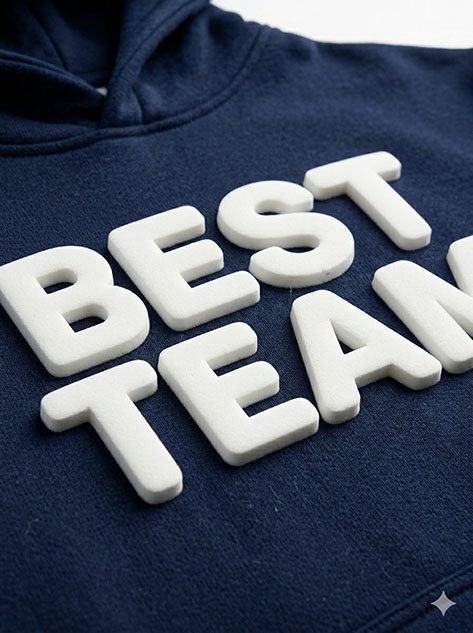
3D Embossing
Specialty Prints and Accents
- Reflective and Fluorescent / Neon Inks add safety features or eye-catching glow for streetwear hoodies and active T-shirts, especially popular in urban or performance lines.
- Rhinestone / Heat-Set Crystals bring sparkle and glamour—often combined with prints for high-impact designs on tees or denim shirts.
- Tie-Dye creates organic, retro patterns with unique variations on lightweight tees or hoodies for artisanal appeal.
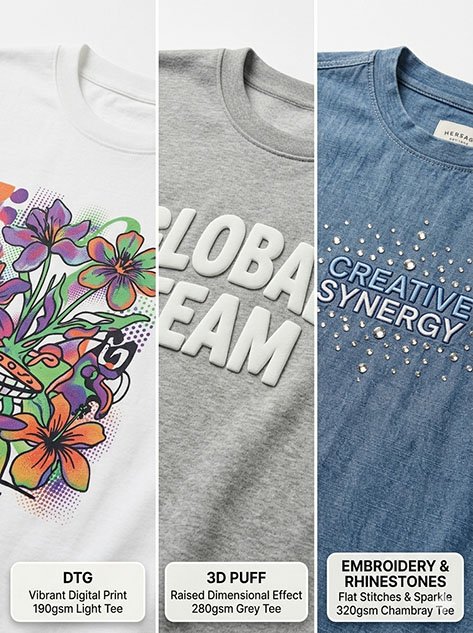
Specialty Prints and Accents
Embroidery and Stitching Variations
- Flat Embroidery and Digital Embroidery produce clean, professional logos with excellent durability, especially on structured denim shirts or heavier fabrics.
- Towel / Chenille Embroidery offers plush, textured depth that feels luxurious on hoodies.
- Toothbrush Embroidery creates distinctive brush-like or textured stitch effects for unique artistic flair.
- Embroidered Patches / Appliqué allow layered or detachable designs, adding versatility to tees, hoodies, or denim pieces.
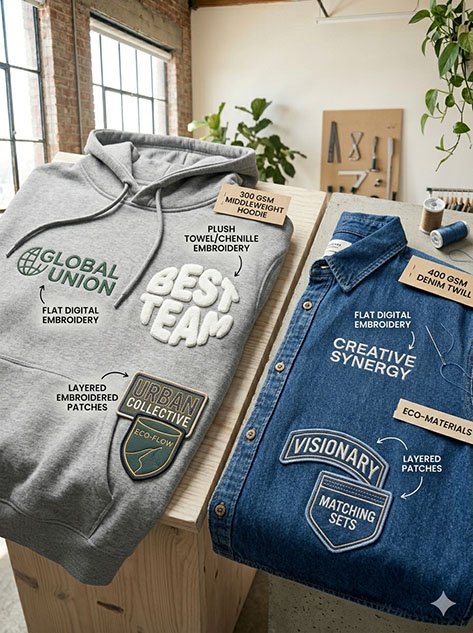
Textile Embroidery Texture Differences
Artistic Finishes
- Hand-Painted Effects deliver exclusive, one-of-a-kind looks that stand out in limited collections.
Many brands mix techniques on a single garment—for example, screen printing + flat embroidery on a denim shirt, or puff + reflective + embroidered patches on a hoodie—for maximum impact. Lighter fabrics (190-300gsm) suit delicate DTG or hand-painted work, while heavier weights (400-600gsm) support robust embroidery, puff, silicone, and denim washing processes without losing structure.
For startups, the advantage is clear: small MOQ flexibility, in-house R&D for technique testing, and strict quality control from yarn to finished garment.
Challenges in New Clothing Design and Production
Launching new POD collections often reveals hurdles:
- Design Translation Issues: Colors may shift in fluorescent or reflective prints; fine details can get lost in embroidery on textured denim; puff or 3D embossing may crack on stretchy lighter tees.
- Fabric and Technique Mismatches: A too-light fabric won’t support heavy 3D effects or structured embroidery, while overly heavy material can feel stiff for everyday T-shirts. Compatibility with washes (especially on denim) is critical.
- Production and Scaling Problems: Inconsistent quality from old suppliers, extended lead times, or high minimums that limit experimentation with specialty methods like tie-dye, rhinestone, or towel embroidery. Shrinkage, elasticity issues in blends, and wash durability (e.g., fading neon or peeling silicone) are common pain points.
- Brand Consistency When Switching Suppliers: Maintaining the same premium feel across mixed T-shirt, hoodie, and denim lines can be tricky.
Real examples include misaligned embroidered patches, stiff 3D textures on lightweight bases, or reduced vibrancy after multiple washes on hoodies. Experienced manufacturers mitigate these through pre-production sampling, fabric-technique compatibility testing, and end-to-end support—from digital mockups to final delivery.
Répondre aux doutes courants des propriétaires de marques
Many established startups share similar questions when exploring new suppliers:
- “Which techniques deliver the best premium feel within my budget?”
- “Can I realistically combine multiple methods—like embroidered patches + puff printing + reflective accents—on one hoodie or denim shirt?”
- “How do specialty processes affect MOQ, cost, and timelines for new designs?”
- “Are these effects (puff, flock, silicone, fluorescent) durable enough for repeated washing and daily wear?”
The good news is that with a capable partner offering wide GSM ranges (190-600gsm) and proven expertise in both knit and woven apparel, even complex combinations become feasible at competitive small-batch pricing. Transparency in testing and quality assurance builds confidence.
If you’re an established brand feeling limited by your current setup, these doubts are normal—but solvable. Advanced customization not only elevates perceived value but also drives customer loyalty through unique, high-quality products.
Conclusion
Print on Demand shirts unlock tremendous potential when you harness diverse customization techniques—from DTG, screen printing, and heat transfer to puff, flock, silicone, various embroidery styles (flat, towel, toothbrush, patches), reflective/fluorescent, rhinestone, tie-dye, hand-painted effects, and 3D textures—matched with suitable fabrics in the 190-600gsm range.
For growing brands seeking a new supplier, a one-stop partner with small MOQ support, rich experience in T-shirts, hoodies, denim, and hybrid items can transform your line from functional to unforgettable.
FAQ
1. What customization techniques work best for lightweight T-shirts (190-300gsm) versus heavyweight hoodies or denim shirts (400-600gsm)? Lightweight tees favor DTG, heat transfer, screen printing, hand-painted effects, and tie-dye for soft results. Heavier hoodies and denim excel with puff, flock, silicone, towel/chenille embroidery, flat/digital embroidery, and reflective accents for durability and structure.
2. How do puff printing, silicone printing, and flock differ in texture and durability? Puff creates a raised, 3D foamy texture (great for bold impact but needs proper curing). Silicone offers a soft, rubbery, highly flexible and wash-resistant finish. Flock provides a velvety, suede-like soft touch with premium feel—each suited to different design goals.
3. Can I combine techniques like embroidered patches, rhinestone, and reflective printing on the same garment? Yes—many brands successfully layer them (e.g., embroidery base + rhinestone accents + reflective elements) for high-impact pieces. Pre-production sampling ensures compatibility and alignment.
4. What are the common challenges when using specialty methods such as tie-dye, hand-painted effects, or towel embroidery? Challenges include color consistency (tie-dye), uniqueness vs. scalability (hand-painted), and added thickness/durability testing (towel embroidery). Expert partners address these through testing and adjusted processes.
5. Which techniques are most cost-effective for small MOQ POD runs? DTG, DTF/heat transfer, and digital embroidery are often most efficient for very small runs, while screen printing and puff become economical as quantities increase.
6. How do you ensure wash durability for raised prints (puff/embossing) and fluorescent/reflective inks? Through proper ink formulation, multi-stage curing, and rigorous wash testing. Premium suppliers conduct pre-production validation to guarantee longevity.
7. Do you support mixing knit (tees/hoodies) and woven (denim) items with unified customization? Absolutely—one-stop services allow consistent branding and techniques across mixed collections with flexible small MOQs.
8. What should I prepare when inquiring about new techniques or switching suppliers? Prepare your design files (vector/raster), target GSM preferences, quantity estimates, reference samples if any, and specific requirements (e.g., wash standards or sustainability). The more details, the faster we can provide accurate quotes and recommendations.
Services de personnalisation par LYDENIM
🎨 Design personnalisé
Créez votre propre collection de tissus ou vêtement avec les matières haut de gamme de LYDENIM. Des mélanges de coton luxueux aux textiles écologiques innovants, découvrez des couleurs, des tissages et des finitions qui correspondent parfaitement à votre marque ou à votre vision créative. Visitez LYDENIM pour en savoir plus.
🛍️ Solutions de vêtements sur mesure
Donnez vie à vos créations grâce à nos services de confection sur mesure. Costumes sur mesure, robes élégantes ou vêtements de travail résistants, nous garantissons une coupe parfaite, un confort optimal et une qualité durable. Découvrez nos options de personnalisation sur Myalibaba.
📩 Contactez-nous
Vous avez un projet en tête ? Contactez notre équipe au malone@lydenim.com pour discuter de tissus personnalisés, de conception de vêtements ou de solutions textiles durables.
Transformez vos idées en réalité avec LYDENIM, votre partenaire de confiance pour des tissus innovants et de haute qualité et des solutions de vêtements sur mesure.