


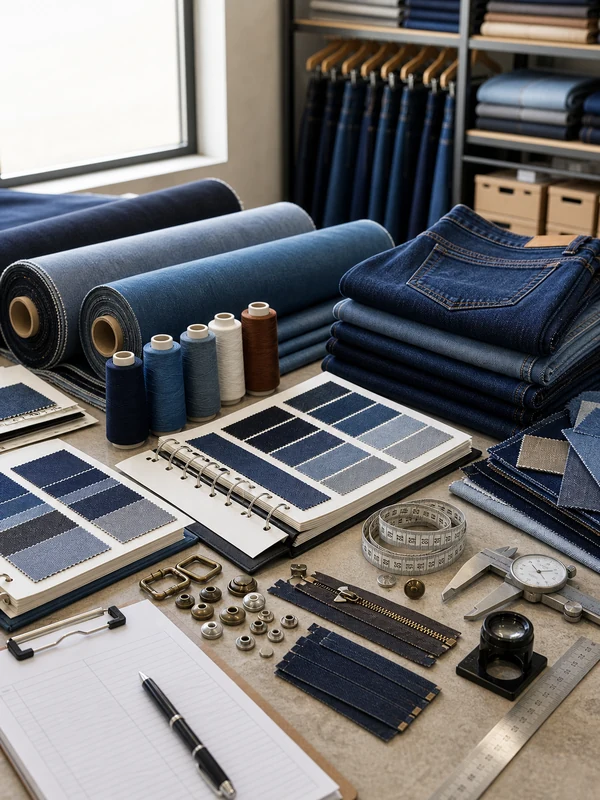
Waktu baca perkiraan: ~5 menit
Untuk menemukan pabrik kain denim yang terpercaya, pastikan tiga hal: kapasitas produksi, konsistensi material, dan stabilitas pesanan jangka panjang. Sebagian besar masalah pengadaan dimulai ketika pembeli tidak bisa membedakan antara pabrik asli dan pedagang perantara. Panduan ini memberikan proses verifikasi yang dapat diulang: tentukan spesifikasi teknis terlebih dahulu, ikuti urutan sampel dan QC yang terstruktur, serta mintalah pernyataan kemampuan sebelum Anda berkomitmen.
Sebelum Anda Meminta Penawaran Harga: Empat Hal Penting
- Fabric construction & weight – Composition (e.g., 98% cotton 2% elastane), weave (e.g., 3/1 right-hand twill), and weight in oz or GSM. A 10.5 oz denim behaves very differently from a 14 oz rigid one.
- Regangan & Pemulihan – Specify elastane content, expected stretch ratio, and recovery target (e.g., >95% after 30 minutes).
- Shade & dyeing method – Indigo rope-dyed, sulfur-dyed, etc. Request a lab-dip or shade band against a standard, not a stock-roll photo.
- Intended wash & finish – Share your wash recipe or a reference garment so the mill can confirm the fabric will deliver the look you need.
Jenis Pemasok & Risiko Pengadaan
| Tipe Pemasok | Aktivitas Inti | Keuntungan | Kekurangan | Terbaik untuk |
|---|---|---|---|---|
| Pabrik denim spesialis | Memiliki rope-dyeing, weaving, finishing; menjalankan produksi berkelanjutan | Kontrol mendalam terhadap nuansa warna, sentuhan tangan, penyusutan; mampu merekayasa pencucian. | MOQ warna kustom sering 3,000–4,000 m; tidak ada pembuatan garmen | Merek yang membutuhkan kain yang dikembangkan khusus |
| OEM/ODM Terintegrasi | Pengadaan kain/penenunan in-house + potong-jahit-cuci; menghasilkan celana jeans jadi | Akuntabilitas satu titik dari kain hingga garmen; mengurangi celah laundry | Bekerja pada MOQ garmen (300–500 pcs/style); dapat melakukan outsourcing untuk benang khusus | Layanan paket lengkap untuk merek/startup |
| Trading company | Mendapatkan pasokan gulungan grey/finished dari berbagai pabrik dan menjualnya kembali. | Fleksibel untuk jumlah kecil; respons cepat; stok lot | Tidak ada kontrol produksi; rona, penyusutan, dan ketersediaan dapat berubah antar lot tanpa pemberitahuan. | Proyek cepat, pengisian ulang stok |
| Konverter kain denim | Membeli kain greige dan mengatur pencelupan, pelapisan, atau finishing eksternal. | Pencucian unik, pelapisan, efek permukaan | Kualitas bergantung pada finisher pihak ketiga; lead time dan konsistensi lebih sulit dijamin | Merek berbasis desain yang mengeksplorasi finishing khusus |
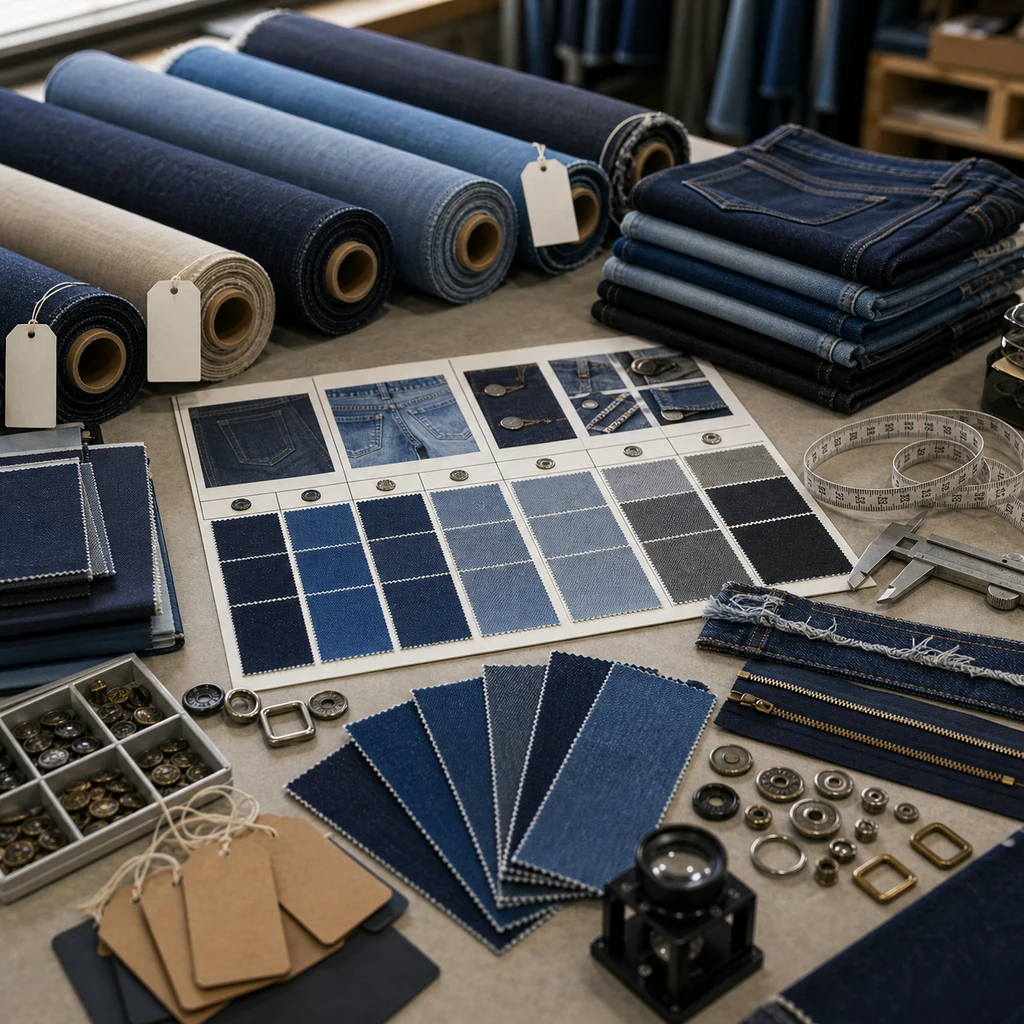
Urutan Sampling dan QC yang Mendeteksi Risiko
- Fabric swatch + lab-dip/shade band – Evaluate under natural and indoor light.
- Yardase sampel (2–5 m) – Test shrinkage (formula: (before − after) ÷ before × 100%), twist, and hand feel independently. Insist on shrinkage data after a full garment wash cycle, not a relaxed fabric test.
- Sampel pra-produksi (PPS) – Must use bulk fabric, trims and the actual wash recipe. Measure all point-of-measure points against agreed tolerances.
- Bulk lab-dip & shade-band approval – Include the accepted light‑medium‑dark range; critical for dark indigo.
- Crocking test – Wet and dry according to AATCC 8. Dark indigo/black that crocks too much leads to return risks.
- Stretch recovery test – Set a fixed elongation (e.g., 80% of maximum stretch) and a rest period; recovery should stay above 90–95%.
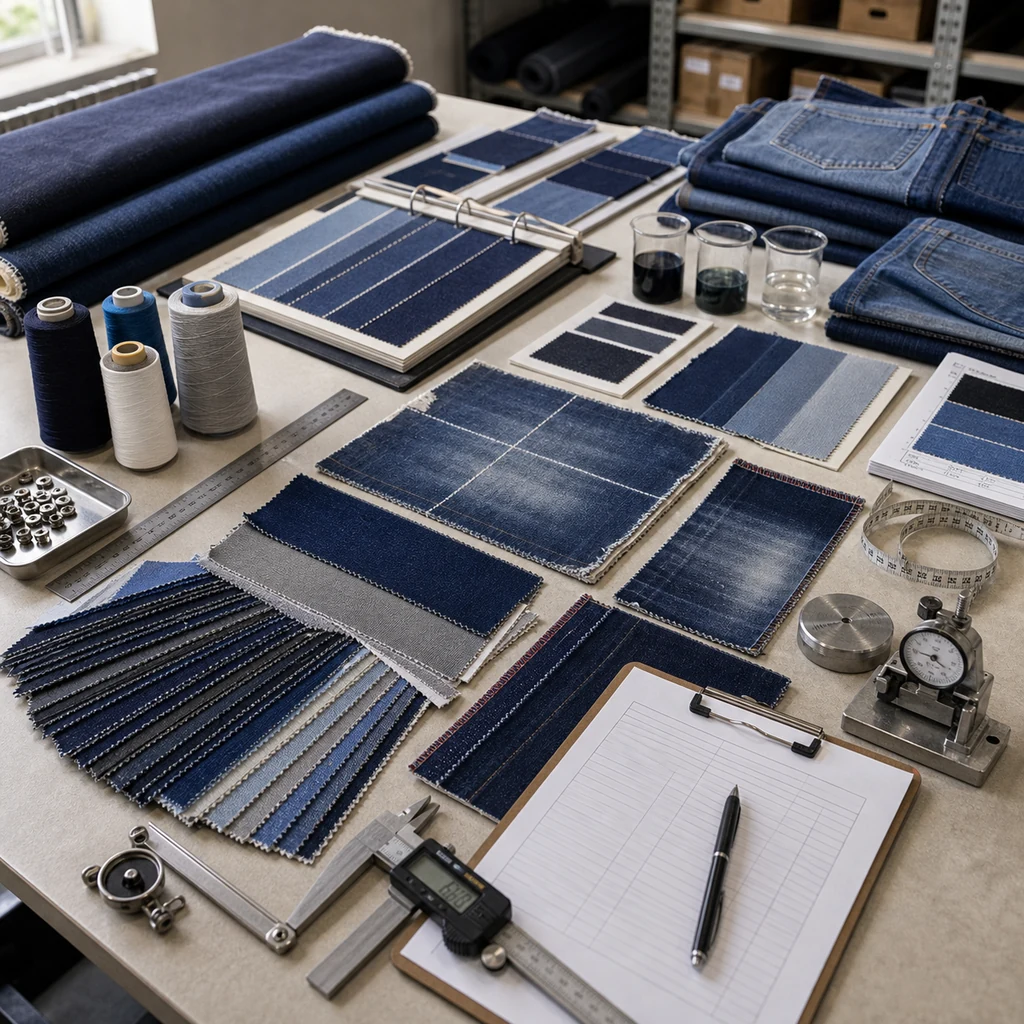
Kesalahan umum
- Menilai pabrik hanya dari satu sampel kecil – itu tidak memberi tahu Anda apa pun tentang konsistensi roll-to-roll.
- Menyetujui sampel yang menggunakan kain atau cuci yang berbeda dari pesanan massal.
- Menentukan spesifikasi secara berlebihan tanpa mengecek MOQ sebenarnya untuk parameter kustom Anda.
- Membiarkan penyusutan dan skewing tidak terdefinisi – Anda tidak dapat menolak produksi massal yang menyusut 4% bukan 1.5%.
- Melewatkan pernyataan kemampuan pemasok; pabrikan sejati menunjukkan jalur pencelupan/penenunan, sementara jawaban yang samar sering kali mengindikasikan perusahaan dagang.
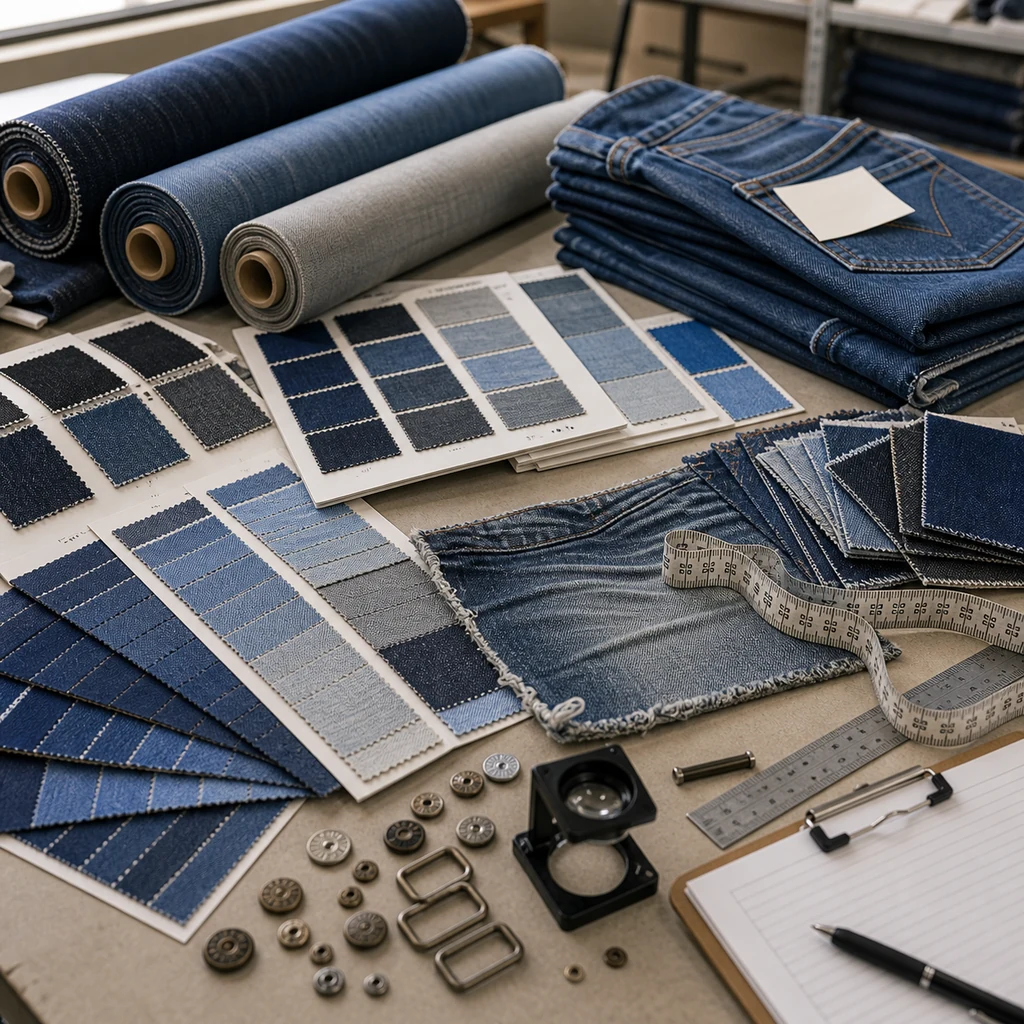
Daftar Periksa Pra‑Penawaran
- Komposisi kain, konstruksi, berat target (oz atau GSM)
- Referensi lebar dan warna yang diperlukan (lab-dip, Pantone, sampel fisik)
- Spesifikasi stretch (elastane %, stretch ratio, recovery target)
- Metode pewarnaan dan persyaratan ketahanan luntur (tahan gosok, tahan cahaya, tahan cuci)
- Proses pencucian yang dimaksud atau hasil akhir garment
- Perkiraan jumlah per warna dan jadwal pengiriman
- Persyaratan pengemasan (panjang roll, core, pelabelan)
- Persyaratan pengujian dan laboratorium pihak ketiga yang disepakati
- Sertifikasi yang diperlukan (GOTS, OCS, OEKO-TEX, BCI) yang mencakup lot spesifik ini
Pertanyaan Wawancara Pemasok
- Apakah kain ini diproduksi di jalur pencelupan dan penenunan sendiri, atau Anda membeli kain grey?
- Dapatkah Anda menunjukkan tampilan langsung atau video terbaru dari lini pencelupan dan alat tenun yang sedang menjalankan jenis kain kami?
- Berapa MOQ yang tepat untuk warna dan konstruksi yang saya tentukan, dan biaya setup apa saja yang termasuk?
- Berapa siklus pencucian dan pada suhu berapa Anda menguji penyusutan, dan berapa batas lulus/gagal Anda?
- Apakah PPS dibuat dari dye lot dan batch kain yang sama dengan bulk? Jika tidak, bagaimana kontinuitas shade dijamin?
- Tindakan perbaikan apa yang Anda lakukan jika warna massal berada di luar rentang warna yang telah disegel?
- For stretch fabrics, can you provide a recovery test report at the elongation I specify?
- Laboratorium pihak ketiga mana yang Anda gunakan, dan dapatkah laporan dicantumkan atas nama perusahaan kami?

Pertanyaan umum
Denim apa yang sebaiknya dipilih oleh startup untuk celana jeans kustom?
Sebagian besar celana jeans kustom bekerja dengan baik dalam denim 12–14 oz. Pilih kandungan katun, stretch, dan efek cuci berdasarkan fit, susut, dan positioning ritel.
Bagaimana cara merek kecil menemukan produsen yang andal?
Verifikasi melalui sampel kain, pengalaman produksi sebelumnya, ketentuan MOQ yang jelas, kualitas sampel, dan transparansi. Pemasok yang menjelaskan keterbatasan seringkali lebih dapat dipercaya daripada yang menyetujui segala sesuatu.
Bagaimana cara saya memverifikasi klaim denim berkelanjutan?
Minta nomor sertifikat, tanggal berlaku, dan dokumen lingkup (GRS, OCS, OEKO-TEX, BCI). Sertifikat harus mencakup material spesifik yang dibeli.
Mengapa sampel terlihat bagus tetapi produksi massal mengecewakan?
Hal ini sering terjadi ketika sampel dipotong dari gulungan stok yang dipilih secara manual, sementara produksi massal dibuat dalam kondisi pencelupan atau finishing yang berbeda. PPS dari lot yang sama dan pita corak yang tersegel sangat penting sebagai tolok ukur.
Bisakah saya memulai dengan MOQ rendah untuk denim kustom?
Kain stok mendukung jumlah yang lebih kecil, tetapi Anda menerima corak dan sentuhan tangan yang tersedia. Denim warna kustom biasanya membutuhkan 3.000–4.000 m per warna; jacquard atau pola khusus kadang-kadang dapat dimulai dari beberapa ratus meter.
Conclusion: Verify Before You Order
Memilih produsen kain denim adalah proses verifikasi, bukan keputusan satu langkah. Tentukan spesifikasi, tipe pemasok, tahapan sampling, dan pemeriksaan kualitas secara berulang. Langkah praktis selanjutnya: minta contoh fisik dengan lab-dip atau shade band dari produsen yang sudah masuk daftar pendek dan uji terhadap persyaratan Anda sebelum negosiasi harga.
Kesimpulan
Gunakan daftar periksa artikel, persyaratan sampel, dan pertanyaan kepada pemasok untuk memastikan langkah pengadaan praktis selanjutnya sebelum melanjutkan ke penawaran harga atau produksi.
layanan personalisasi dari LYDENIM
🎨 Desain Khusus
Design your own fabric collection or garment with LYDENIM’s premium materials. From luxurious cotton blends to innovative eco-friendly textiles, explore colors, weaves, and finishes that match your brand’s product direction. Visit LYDENIM Untuk mengetahui lebih lanjut.
聊城: Solusi Pakaian Khusus
Bring your designs to life with custom garment services. Whether you are developing jeans, denim jackets, skirts, workwear, or small-batch fashion collections, LYDENIM can support fit, comfort, durability, and production planning. Explore customization options on My Alibaba.
📥 Hubungi Kami
Memiliki proyek yang ingin Anda wujudkan? Hubungi tim kami di Malone@lydenim.com to discuss custom fabrics, garment design, low-MOQ sampling, or sustainable textile solutions.
Transform your ideas into reality with LYDENIM–your trusted partner for innovative, high-quality fabrics and bespoke apparel solutions.
Need help turning this into a production-ready sourcing brief?
Send your target product, fabric direction, quantity and sample needs. LY Denim can help compare options and prepare a quote.