


Estimated reading time: ~7 minutes
Geometric jacquard denim can make a collection look sharp, engineered, and premium, but it is less forgiving than irregular motifs. Straight lines, repeated blocks, grids, diamonds, and crosses expose skew, shrinkage, seam mismatch, and wash distortion very quickly. That is why buyers should not select a geometric jacquard only from a mood image. They need to confirm how the repeat behaves on the actual garment.
For sourcing teams, the key question is not “Does the pattern look clean on the swatch?” The practical question is whether the repeat size, garment panel, wash route, and marker plan can preserve the design through sampling and bulk production. When those points are defined early, geometric jacquard denim can be developed into a strong B2B program. When they are ignored, the same pattern that looked precise in development can look uneven after washing or assembly.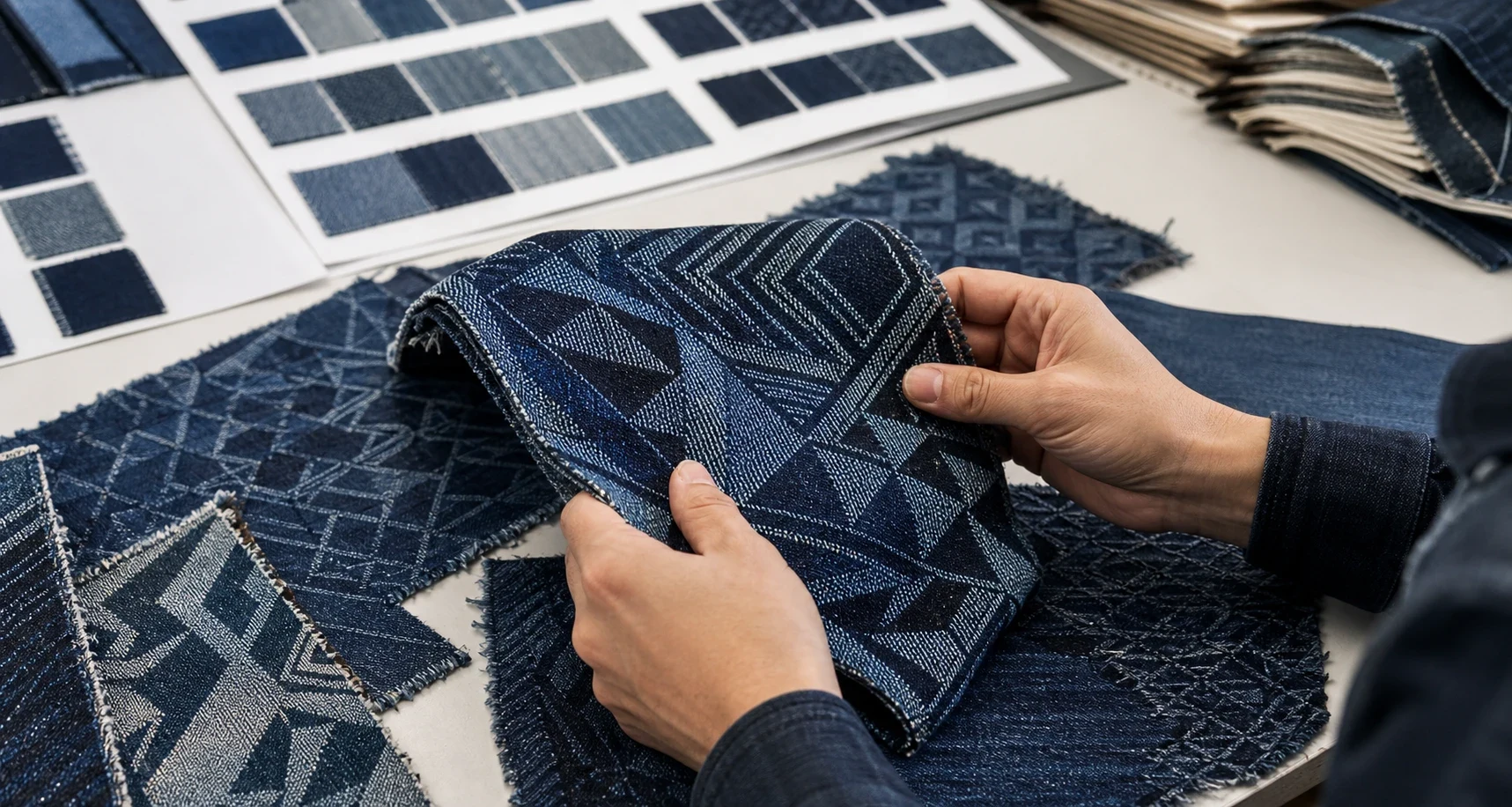
Buyer Summary
- Geometric jacquard denim uses a woven repeat, so pattern accuracy depends on fabric construction, not surface print only.
- Small, medium, and large repeats behave differently on shirts, jeans, jackets, and cut panels.
- Straight motifs reveal skew, shrinkage, and seam mismatch faster than irregular motifs.
- Wash approval should happen together with repeat approval, not after the pattern is already confirmed.
- Marker efficiency and seam planning matter because geometric alignment can increase waste if the garment needs matching.
What Geometric Jacquard Denim Is
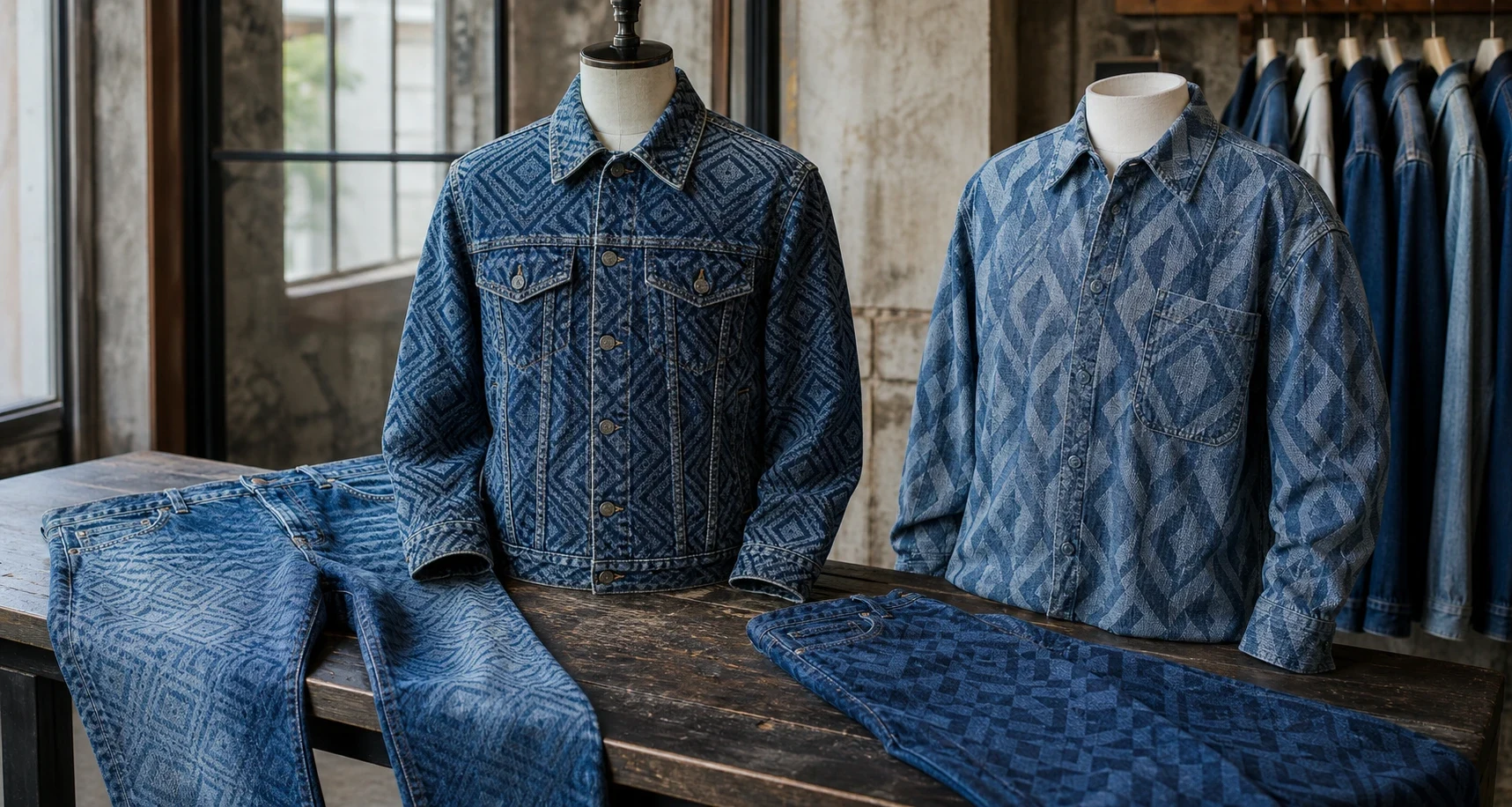
Geometric jacquard denim builds the motif into the fabric through woven structure. The design may be a clean stripe, a compact diamond, a grid, a cross, or a more abstract architectural repeat, but the main idea is the same: the pattern is structural and repeat-based. That gives the fabric more depth and authenticity than a simple printed effect, but it also creates higher expectations for consistency.
From a buyer perspective, geometric jacquard should be evaluated as both a design feature and a production variable. The pattern affects how the fabric is cut, where seams can sit, how shrinkage will be noticed, and whether the garment can tolerate partial mismatch. It also affects the commercial side because tighter repeat control can reduce marker flexibility and add inspection pressure during bulk.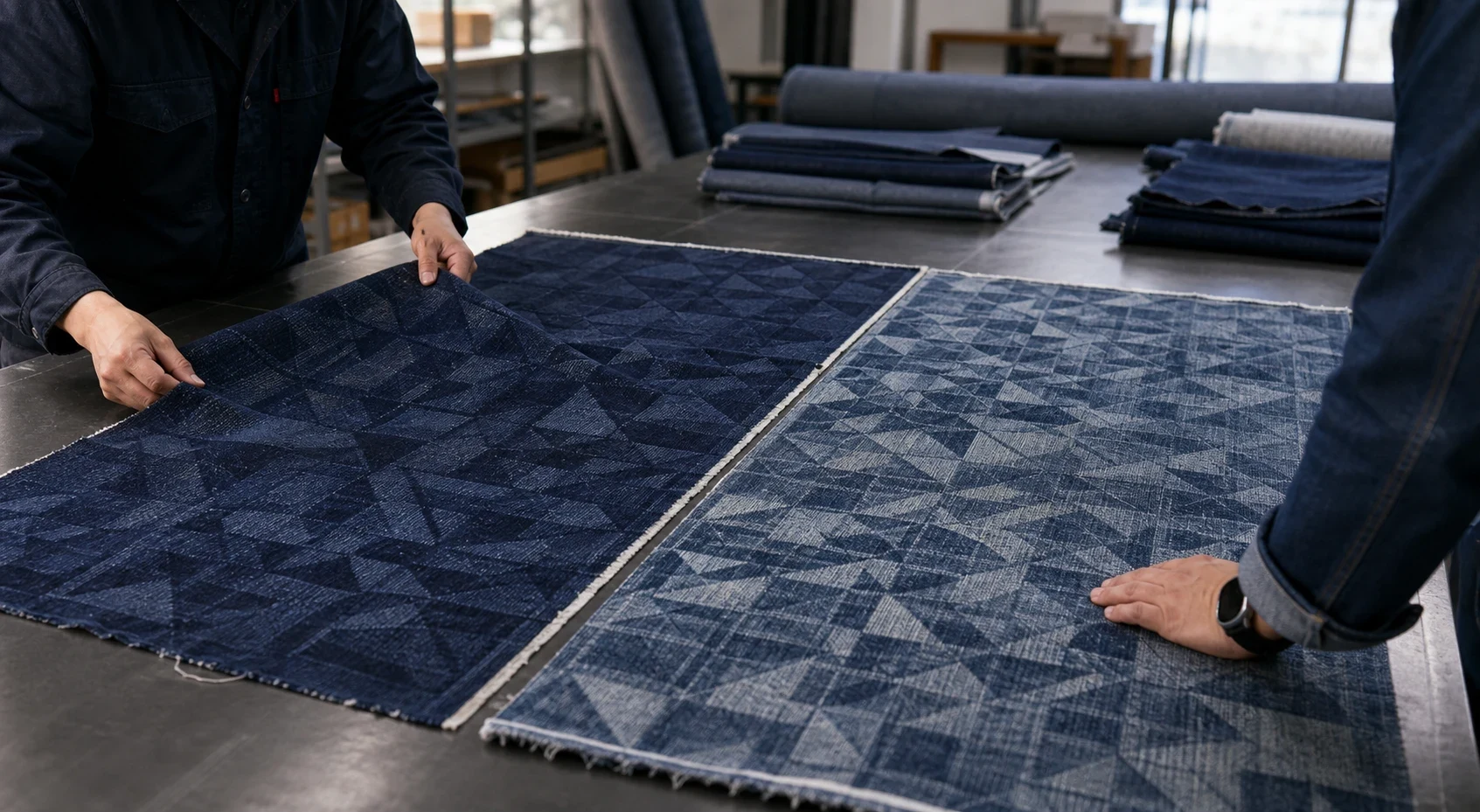
Common Motif Families and Repeat Scales
Not every geometric direction creates the same sourcing risk. Buyers usually benefit from separating the motif family from the repeat scale before they ask for a quote.
| Motif family | Typical use | Main sourcing advantage | Main risk |
|---|---|---|---|
| Diamond or lattice | Jackets, overshirts, statement denim | Premium woven identity and strong visual rhythm | Diagonal distortion becomes obvious after wash |
| Grid or check | Shirts, lightweight jackets, coordinated sets | Easy to explain in a tech brief and visually precise | Skew and seam mismatch show quickly |
| Stripe-based geometry | Panels, trims, or directional garments | Can elongate the garment visually | Cutting direction must be tightly controlled |
| Cross or block repeat | Fashion denim and category differentiation | Clear repeat story for merchandising | Large repeats can waste fabric on small panels |
| Abstract geometry | Broader fashion use | More forgiving than perfect lines | Easy to overcomplicate without improving wearability |
Repeat scale should also be approved in context. A small repeat may look dense and controlled on a shirt, while the same pattern can disappear on a heavy washed jacket. A large repeat can look premium on a jacket back panel, but it may break awkwardly across pockets or narrow plackets.
How Pattern Scale Changes by Garment Type
The best repeat size depends on how much uninterrupted panel space the garment offers.
| Garment type | Small repeat | Medium repeat | Large repeat |
|---|---|---|---|
| Shirt or blouse | Usually the safest option | Good if drape is stable | Can break too often at seams |
| Jacket or overshirt | Can work but may feel too busy | Often the most balanced choice | Strong option when panels are broad |
| Jeans or bottoms | Good for subtle surface identity | Possible on wide-leg or relaxed fits | Risky on pocket-heavy silhouettes |
| Skirt or dress panel | Good for all-over use | Strong if placement is planned | Works best on simple panel layouts |
For private-label and OEM buyers, repeat scale should be reviewed on the intended panel map, not as an isolated swatch decision. A precise repeat can become inefficient if the style requires pocket placement, shaped yokes, or high seam visibility.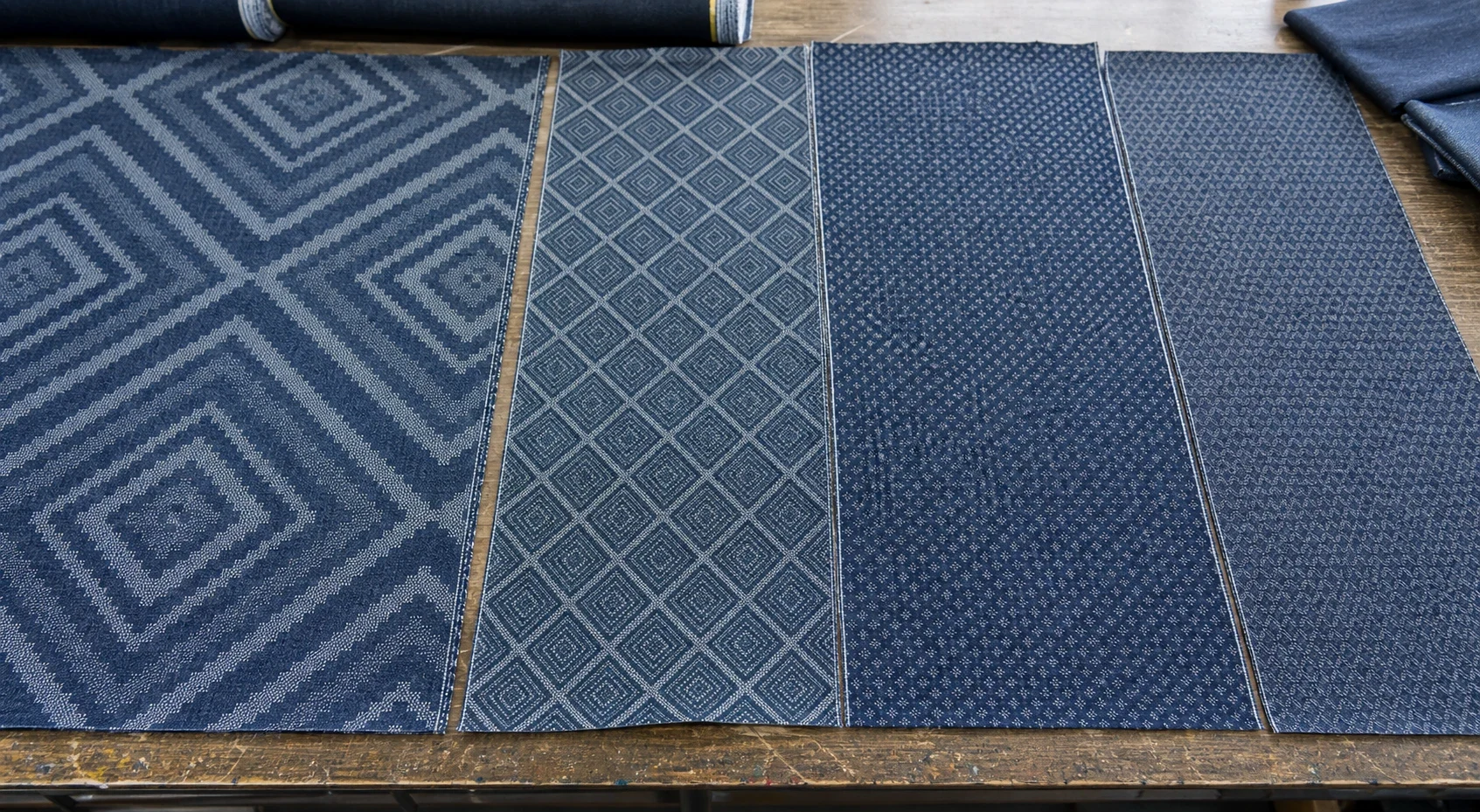
Wash, Shrinkage, Skew, and Contrast Behavior
Geometric jacquard should be tested with the intended wash route early. A mild rinse may preserve line clarity, while heavier wash routes can soften contrast, shift dimensions, and make the pattern appear less clean. Straight motifs are particularly sensitive because even modest skew becomes noticeable when the eye expects symmetry.
Buyers should pay attention to:
- dimensional shrinkage after wash
- skew or spirality that changes the angle of lines
- contrast loss between the geometric motif and ground
- surface flattening if the weave relies on relief
- seam pull that makes the repeat look offset
This does not mean geometric jacquard is fragile by default. It means the acceptance standard has to describe what counts as normal wash character and what counts as unacceptable distortion.
Cutting, Seam Matching, and Marker Efficiency
The cleanest geometric articles often come from simpler pattern layouts. If a brand wants perfect or near-perfect seam matching, that should be declared at development stage because it influences yield, cutting direction, and sometimes garment design decisions.
Use a seam-matching guide like this:
- Decide whether the design needs exact matching, visual balance, or only general continuity.
- Mark the highest-priority zones such as center front, pocket line, side seam, or yoke.
- Accept that better matching usually reduces marker efficiency.
- Confirm whether shrinkage is measured before or after wash approval.
Many buyers do not need perfect alignment everywhere. They need good alignment where the customer will notice it most. That decision can protect both quality and cost.
Sample and Bulk QC Checklist
Before approving bulk, run a checklist that combines design and production control:
- Confirm repeat size on the actual garment pattern.
- Check pre-wash and post-wash contrast under the same light source.
- Measure shrinkage and record acceptable tolerance.
- Review skew and line direction after wash.
- Inspect seam areas for visible mismatch.
- Compare bulk strike-offs or loom samples against the approved standard.
- Define whether shade variation changes the readability of the repeat.
If the pattern is a core selling point, include bulk inspection photos or panel references in the approval pack. This helps the supplier and the buyer audit the same visual standard.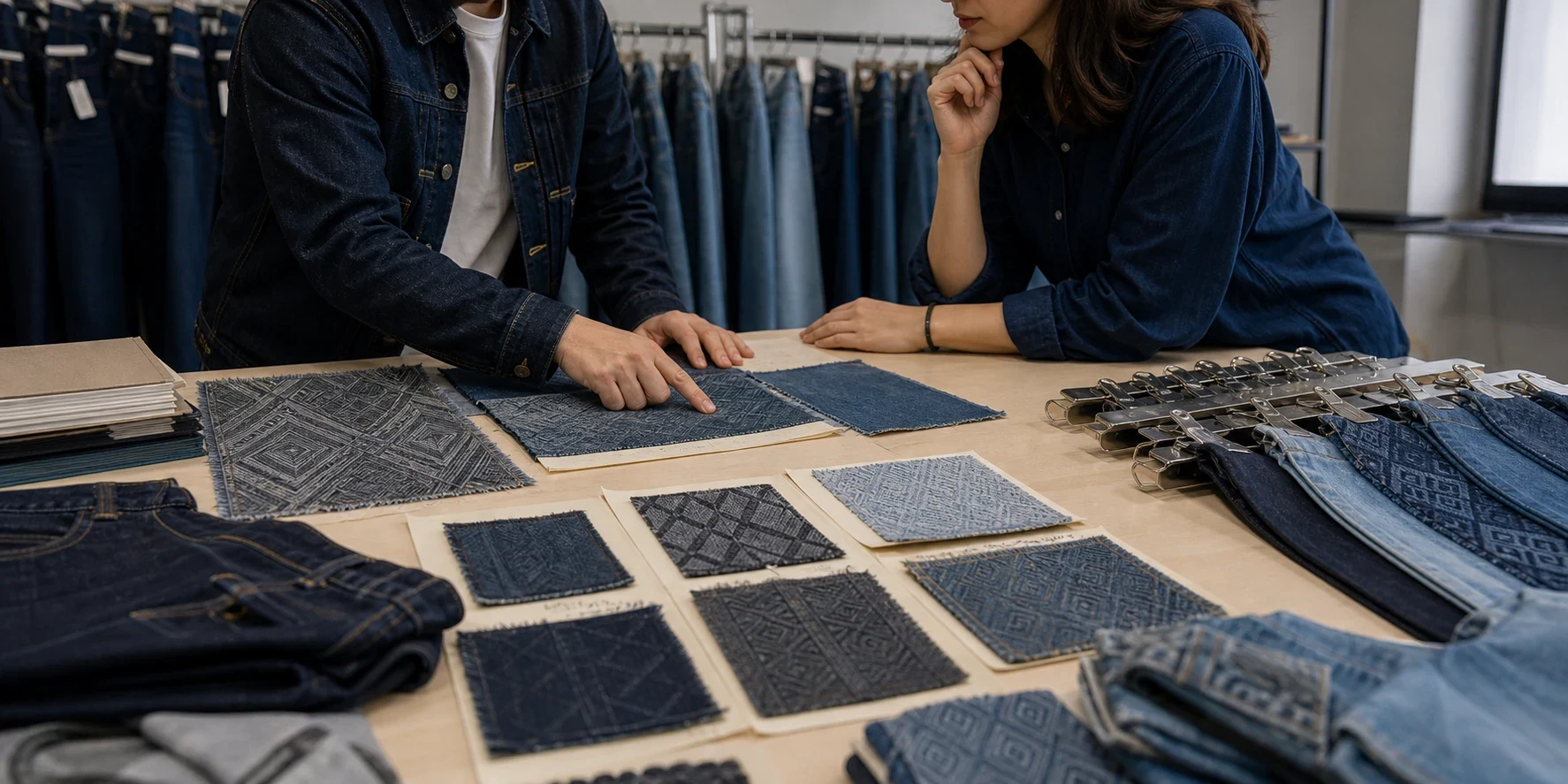
FAQ
Is geometric jacquard denim better than printed geometric denim?
It depends on the collection goal. Woven jacquard usually gives more structural depth and a stronger material story, but it also requires tighter repeat and QC control than a simple surface print.
What repeat size is safest for apparel?
There is no universal best size. Shirts and smaller panels usually handle compact repeats better, while jackets and larger panels can support medium or larger repeats more effectively.
Does seam matching always need to be perfect?
No. Many commercial programs only need matching in high-visibility areas. The level of matching should be defined before quoting because it affects yield and cutting efficiency.
Why should wash testing happen early?
Because shrinkage, skew, and contrast changes can change the look of the motif. For geometric repeats, those changes are often more visible than they would be on irregular designs.
Geometric Jacquards To Judge With Real Swatches
Straight lines and repeated shapes look simple on screen, but the sample tells you whether the scale feels right on a garment.
Diamond Jacquard Fabric 53354
Want a diamond pattern that looks tidy instead of busy? Diamond Jacquard Fabric 53354 is useful as a swatch check for spacing around pockets, side seams or smaller panels.
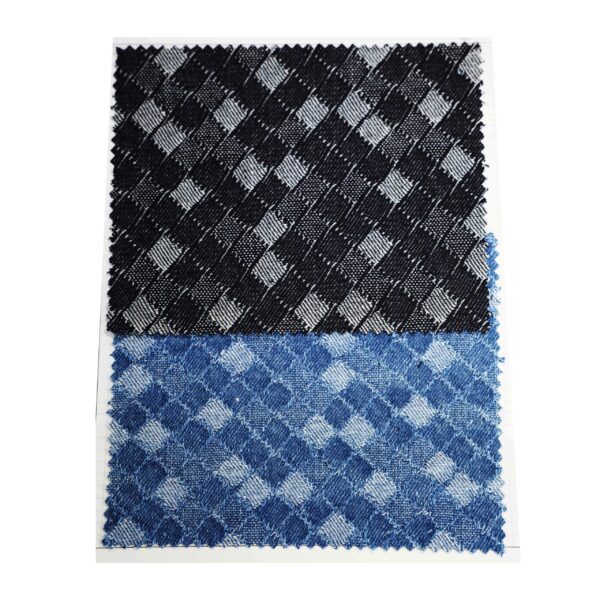
Check the diamond spacing in this swatch view and decide whether the repeat feels clean enough for smaller panels.
Cross Jacquard Fabric 53203
Planning a cross or linear pattern? Cross Jacquard Fabric 53203 lets the team see how straight lines may land across pockets, plackets and panel breaks.
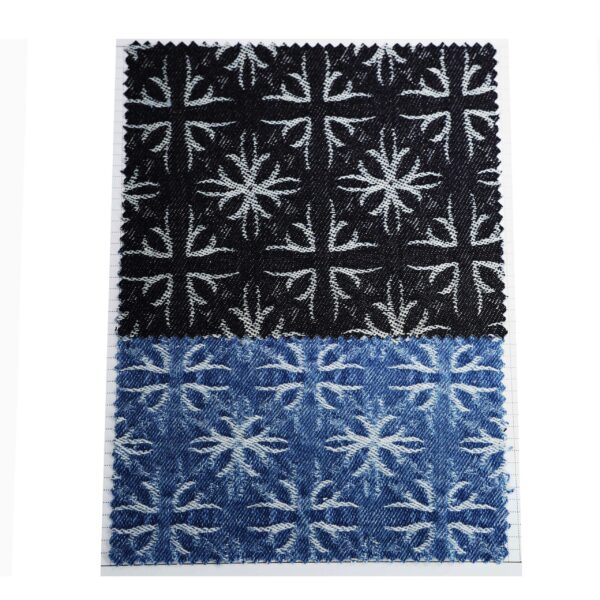
Use this view to judge how the linear pattern may sit across pockets, plackets, and panel breaks.
Large Triangle Jacquard Fabric 53355
Need a stronger geometric look from farther away? Large Triangle Jacquard Fabric 53355 gives a larger-scale pattern to hold against the garment size range.
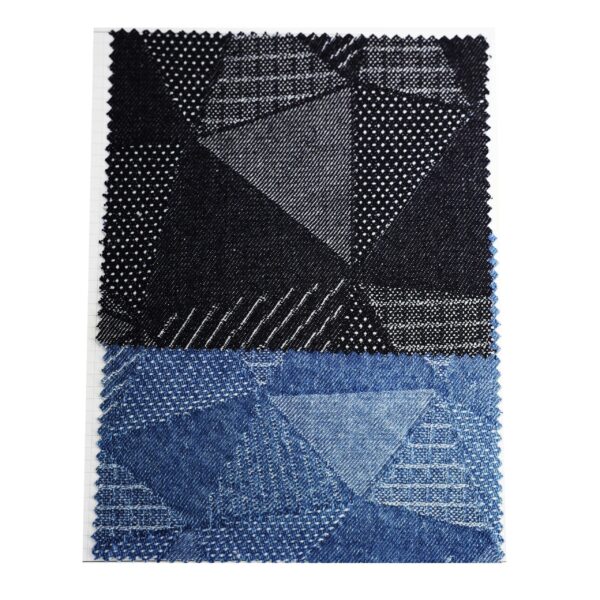
Review the larger triangle scale before using it on smaller garment pieces or narrow panels.
Next Steps with LYDENIM
To compare broader repeat families, review the LYDENIM Geometric Jacquard range and send your target repeat, garment panels, wash route, and inspection priorities through the LYDENIM fabric RFQ form.
Conclusion
Geometric jacquard denim works best when buyers manage it as a precision fabric, not only a visual trend. The repeat family, scale, wash route, seam priority, and inspection standard all affect whether the finished garment still looks clean after production. If those controls are defined before sampling, the fabric can deliver a strong premium result without unnecessary rework.
Customization Services by LYDENIM
🎨 Custom Design
Design your own fabric collection or garment with LYDENIM’s premium materials. From luxurious cotton blends to innovative eco-friendly textiles, explore colors, weaves, and finishes that match your brand’s product direction. Visit LYDENIM to learn more.
🛍️ Tailored Garment Solutions
Bring your designs to life with custom garment services. Whether you are developing jeans, denim jackets, skirts, workwear, or small-batch fashion collections, LYDENIM can support fit, comfort, durability, and production planning. Explore customization options on My Alibaba.
📩 Get in Touch
Have a project in mind? Contact our team at malone@lydenim.com to discuss custom fabrics, garment design, sampling and production planning, or sustainable textile solutions.
Transform your ideas into reality with LYDENIM–your trusted partner for innovative, high-quality fabrics and bespoke apparel solutions.
Need help turning this into a production-ready sourcing brief?
Send your target product, fabric direction, quantity and sample needs. LY Denim can help compare options and prepare a quote.